Compare
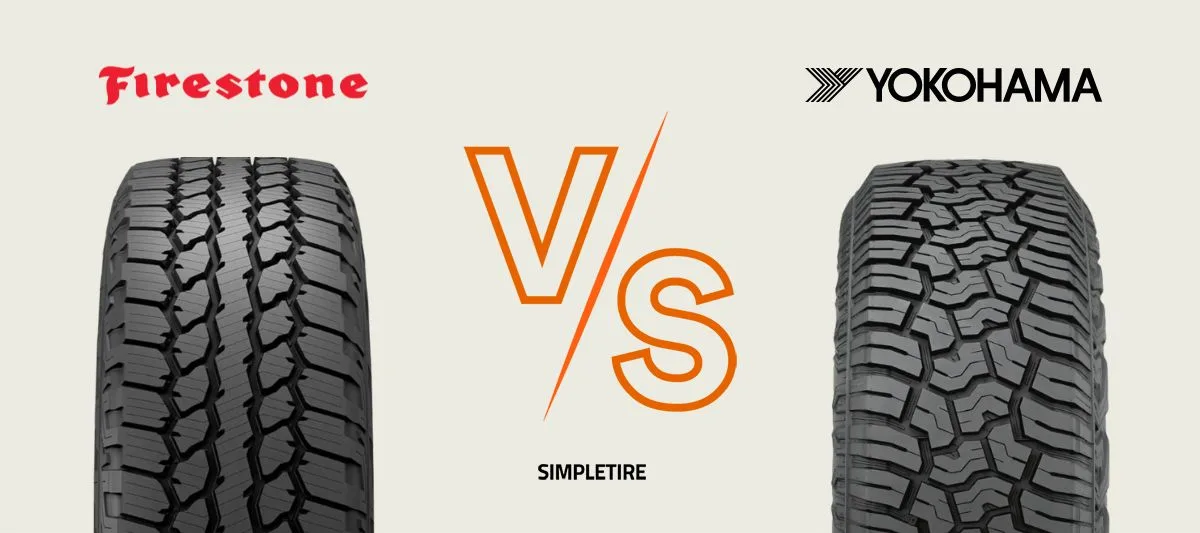
Firestone Destination A/T2 vs Yokohama Geolandar X-AT tires
Free shipping
Best price guarantee
SimpleCrew exclusive savings
0% APR Financing
Tire replacement coverage
24/7 roadside assistance
Easy returns
Compare
For more than a century, the American tire manufacturer Firestone has been making high-value tires. Now owned and managed by tire giant Bridgestone, Firestone continues to scale its tire innovations. Firestone’s tires in the US serve a wide range of applications, including passenger cars, light trucks, commercial vehicles, OTRs, and farm vehicles. The portfolio of the tire manufacturer stretches from all-season, winter, all-weather, all-terrain, mud-terrain, and rugged-terrain to UHP summer, UHP all-season, and commercial van tires.
Yokohama was founded in Japan in 1917, and this iconic tire manufacturer is now admired for its durable and technology-rich tires. American drivers admire the brand for its on- and off-road driving capability, and specifically, its Geolandar family of tires has earned a huge respect among off-road enthusiasts and adventurers. Whether it is the proprietary GEO-SHIELD construction, long-lasting HD-2 rubber compounding, or aggressive dual-sidewall aesthetics, the Geolandars are impressive in offering high value to the drivers.
Both tire brands compete closely in the all-terrain tires tire category, with the Firestone Destination A/T2 and the Yokohama Geolandar X-AT being the arch rivals. The Destination A/T2 is an all-terrain tire that comes with all-weather driving ability and offers drivers of light trucks, Jeeps, and SUVs the ability to enjoy confident drives on highways along with balanced performance in rough conditions, reliable wet braking performance, and strong grip and traction in severe winter weather. It is also backed by a generous tread life warranty.
Likewise, the Yokohama Geolandar X-AT is an all-terrain tire that can be used on- and off-road, and is designed specifically for heavy-duty pickup trucks, Jeeps, full-size SUVs, and lifted 4x4s. It sports a heavy-duty construction and features an aggressive tread pattern. Plus, it comes with great trail pulling power and has a backing of a tread life warranty.
If you are planning to buy a reliable all-terrain tire for your drive, then this Destination A/T2 vs Geolandar X-AT comparison will take you through the overall capabilities of both tires and give you a deeper analysis of their traction, handling, and longevity abilities based on our proprietary tire rating system SimpleScore.
The Firestone Destination A/T2 made its debut in August 2019 and offers great on-road service and off-road durability. It is suitable for use on SUVs, light trucks, and Jeeps, and optimally balances off-road grip, highway comfort, and year-round performance. It is tuned for enhanced surface-biting ability, long-lasting service life, and optimum resistance to hydroplaning. Additionally, it is also Three Peak Mountain Snowflake (3PMSF) approved for use in moderate to severe winter weather.
Overall, the Destination A/T2 is rated a great 8.5 SimpleScore because of a lasting service life, solid traction, and crisp handling.
Get Firestone Destination A/T2 tires at the best deals for your vehicle here
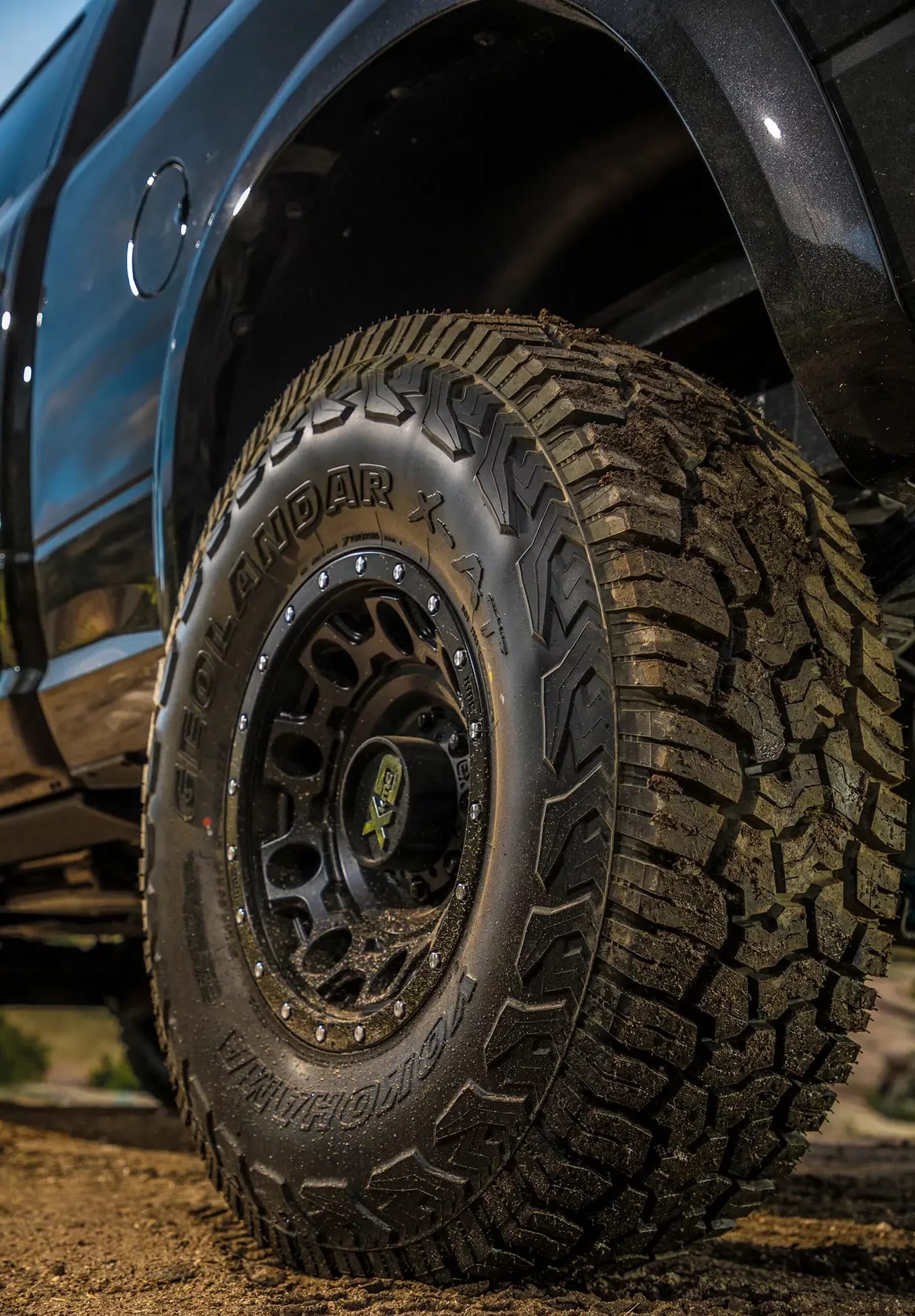
The Yokohama Geolandar X-AT was launched around the same time as its peer, i.e., in July 2019, and it is designed and engineered to perform in off-road conditions while also serving on paved highways and roads. Its key highlight comes in the form of proprietary GEO-SHIELD technology, which incorporates multiple sidewall plies, reinforced construction, and a full nylon cap to offer puncture and sidewall tear resistance. Yokohama has also optimized this tire for stone ejection and solid traction performance in deep mud, sand, and gravel. Additionally, its pattern also controls noise and vibration levels for smooth rides.
Overall, the Geolandar X-AT attains an exceptional 8.6 SimpleScore, thanks to its excellent longevity, sharper handling, and admirable traction performance.
Get Yokohama Geolandar X-AT tires at the best deals for your vehicle here

Now let's examine each tire’s ability on the traction front and learn which one offers better grip in diverse terrain conditions year-round.
The Destination A/T2 earns an 8.5 SimpleScore for its great traction performance in dry, wet, and winter weather conditions. The tread features interlocking 3D sipes and see-through drainage grooves for solid grip in rain, water-logged highways, and gravel. Likewise, the Three Peak Mountain Snowflake (3PMSF) certification brings further assurance of confident grip and performance in moderate to severe winter weather, in temperatures below 45 degrees Fahrenheit.
On the other hand, the Geolandar X-AT gives tough competition to its rival and secures an identical 8.5 SimpleScore in traction. This tire features deep tread voids and an aggressive shoulder pattern with multiple biters to lock and crawl with confidence in challenging conditions. There are stone and mud ejectors that improve clawing grip in mud, loose sand, and rocky paths. For increased dry and wet grip, this tire also features intermediate lugs.
With equally great traction scores, the traction analysis ends in a tie!
ADVANTAGE: Tie
Let’s now move on to the handling part and find out which of the two tires is better at offering better steering response, controllability, confident lane changes, stability, and braking efficiency.
The Destination A/T2 ensures reliable handling with a backing of an 8.2 SimpleScore. The wider footprint, continuous center ribs, and interlocking sipes provide much-needed stability and prevent the tire from lateral flexing. This leads to smooth, crisp, and predictable tracking while driving at highway speeds. There are multiple sipes that improve braking performance on wet and slick roads; likewise, the severe snow rating ensures better ride control and braking performance on snowy terrains.
The Yokohama Geolandar X-AT also doesn’t disappoint with the handling response and achieves an 8.5 SimpleScore in handling. The use of GEO-SHIELD construction and a multi-ply sidewall resists tire flexing while cornering, especially when you are driving under heavy loads. This ensures better stability, reduced block squirm, and great tracking, especially when you are carrying heavy cargo or towing.
In the handling round, the Geolandar X-AT surpasses the Destination A/T2 by a small margin, leading by a 1-0 in the comparison!
ADVANTAGE: Yokohama Geolandar X-AT
Moving on to the longevity analysis, let’s find out which of the two tires is better when it comes to resisting wear, covering more miles, and offering better return on investment.
Starting with the Destination A/T2, it secures an impressive 8.9 SimpleScore in longevity. This tire also comes backed by a 55,000 mile limited manufacturer tread life warranty. Thanks to the full-depth 3D sipes and optimized rubber compound, the tire resists uneven wear for lasting use on highways.
On the other hand, the Geolandar X-AT is marginally ahead with an exceptional 9.0 SimpleScore for its excellent long-lasting ability. This tire is covered by a 50,000 mile limited manufacturer tread life warranty, and its strong and durable HD-2 rubber compound, along with a reinforced GEO-SHIELD carcass and stone ejectors, avoids stone drilling and chunking on gravel to offer long-lasting service in off-road conditions.
No doubt, the Firestone tire offers 5,000 miles extra tread life warranty coverage, but it is the Geolandar X-AT that outshines the peer by a 0.1 higher rating, winning by a 2-0.
ADVANTAGE: Yokohama Geolandar X-AT
Both the Destination A/T2 and the Geolandar X-AT are all-terrain tires and can be used on- and off-road in conditions like mud, sand, dirt, rocks, and gravel. However, only the Destination A/T2 is severe snow rated and can be used in moderate to severe winter weather, in temperatures less than 45 degrees Fahrenheit. So, it is a true all-weather, all-terrain tire, while the Geolandar X-AT is a great choice for year-round utility in dry, wet, and light winter weather if you look for something that can be used on- and off-road.
As far as the rim sizes are concerned, the Destination A/T2 is offered in 15- to 22-inch rim choices, while the Geolandar X-AT tires are offered in 15- to 24-inch rim options.
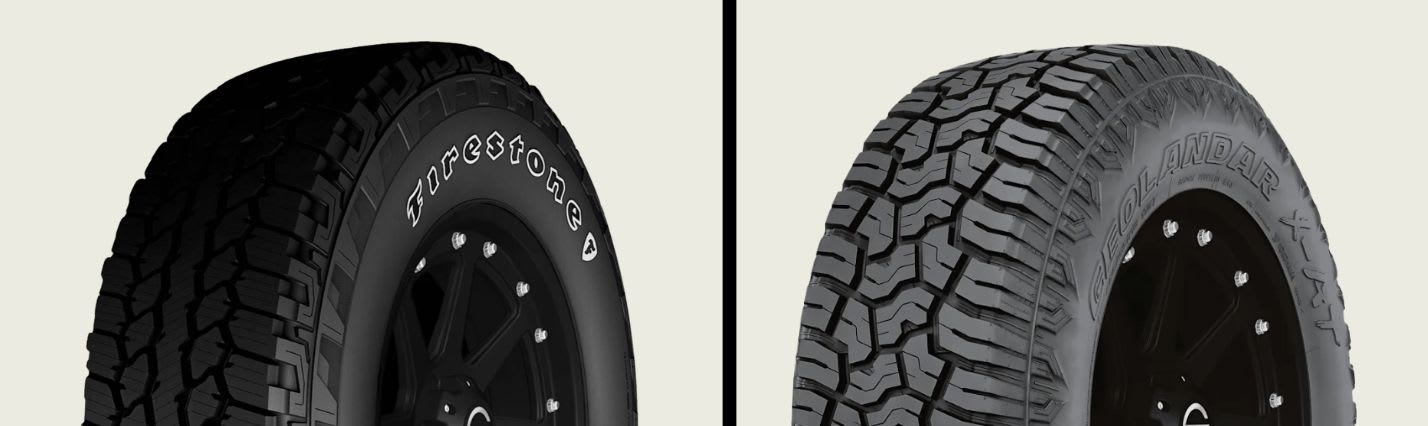
Looking at overall SimpleScores, the Geolandar X-AT is a slightly better option than the Destination A/T2 (8.6 vs 8.5). However, your final buying decision should be based on whether you need a set of tires that prioritizes everyday highway comfort, fuel efficiency, and severe winter utility, or something that’s good at handling and longevity, and comes with a heavy-duty 3-ply construction.
As far as the prices are concerned, the Destination A/T2 is available at a starting price of at least $195 per tire, while the Geolandar X-AT is available at a starting price of at least $235 per tire. This means a set of four Destination A/T2 tires will cost you at least $780, while a set of four Geolandar X-AT tires will cost you at least $940.
Based on SimpleScore, you should consider the Destination A/T2 if you:
On the other hand, you should choose the Geolandar X-AT if you:
Still not sure which tire to buy? Fortunately, SimpleTire is here to help, as our helpful agents are more than happy to assist you in selecting the right tire for your ride and budget.
You may also be interested in:
Bridgestone UltraWeather vs Pirelli Scorpion WeatherActive tires
UltraWeather and Scorpion WeatherActive are two of the best tire lines on the market, but which one is best for you? Let’s break it down with SimpleScore.
Kumho Road Venture RT51 vs Goodyear Wrangler DuraTrac RT tires
Road Venture RT51 and Wrangler DuraTrac RT are two of the best tire lines on the market, but which one is best for you? Let’s break it down with SimpleScore.
Armstrong Tru-Trac SU vs Sumitomo Encounter HT2 tires
Tru-Trac SU and Encounter HT2 are two of the best tire lines on the market, but which one is best for you? Let’s break it down with SimpleScore.
Search By